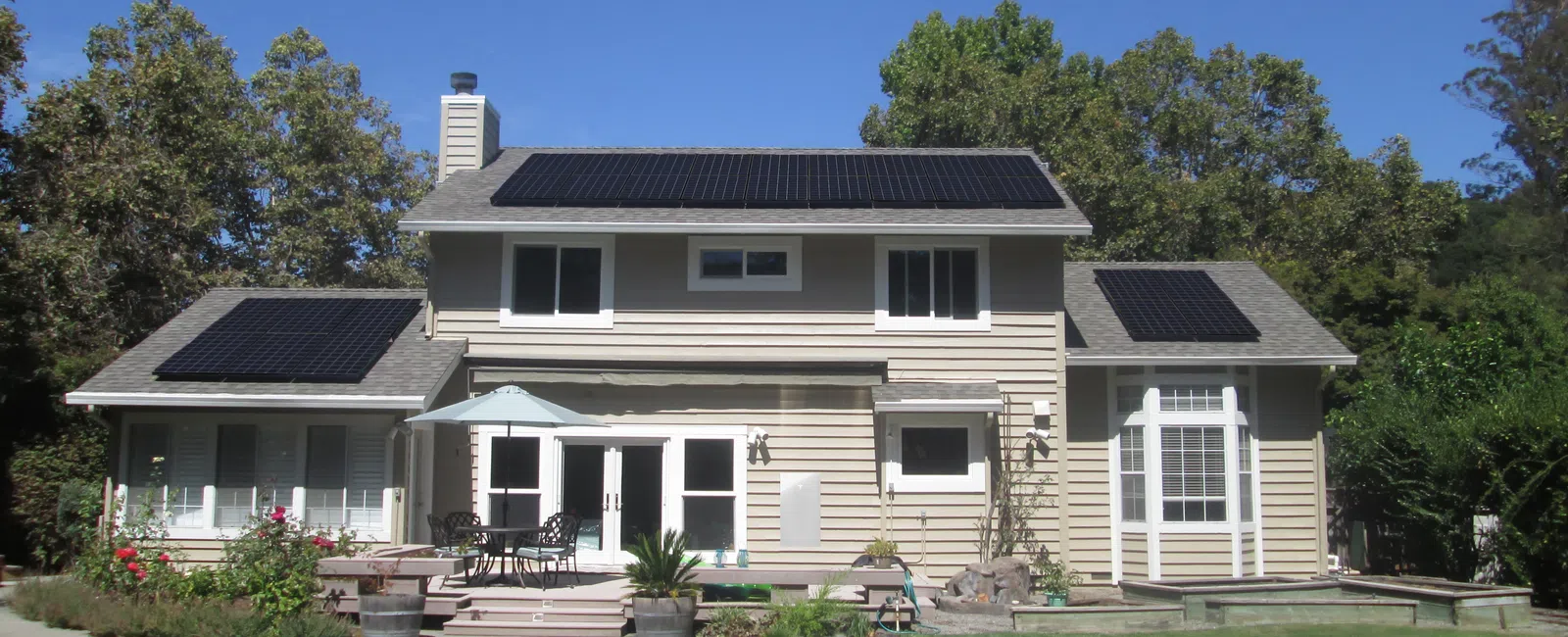
If you've wondered whether your home is a good fit for solar, here's the encouraging news: most North Bay homes are. Solar works on a wide range of houses, roofs, and budgets, and the cases that give people pause usually have a solution. Still, a few things make a home an especially strong candidate, and it's worth knowing what they are.
Your roof
The roof is where most people start, and a few things about it matter.
- Condition. Because solar lasts 25 years or more, it's best to put it on a roof with plenty of life left. If your roof is newer or in good shape, you're set. If it's near the end of its run, handling that first is simpler than doing it later, and we flag it during the site visit so there are no surprises.
- Space. You need enough unshaded area for the number of panels your home calls for. Most roofs have plenty. A smaller roof isn't a dealbreaker either; it just means we design carefully to fit the production you need.
- Type. Solar goes on tile, composition shingle, metal, and flat roofs. Even the foam roofs on Eichler homes, which many companies turn down, are a specialty of ours. Roof type rarely stands in the way. See The Challenges & Solutions of Installing Solar Panels on Eichler Roofs.
Sun and shading
Solar wants sunlight, so the amount your roof gets is a real factor. Homes with open, sunny roofs are ideal candidates.
Shading matters more than most people expect. A tree, a chimney, or a neighboring building that shades part of the roof for hours a day will cost you production. The good news is that shading is something we design around. We map how the sun moves across your roof through the day and place the panels where the light is best. In many cases, options like microinverters let a partly shaded roof still produce well, since each panel produces on its own instead of dragging down its neighbors. And shade isn't always permanent; trimming a tree back can open up a roof that looked marginal at first glance.
Which way your roof faces
Direction affects how much power you make and when you make it. South-facing roofs produce the most over a day, while west-facing roofs make more in the valuable evening hours. East works too, and even a roof with several different angles can make great power with the right design. We get into the details in which direction solar panels should face, but the short version is that few roofs are ruled out by direction alone.
How much power you use
The other half of the picture is your electricity use. The more you use, especially if you have an EV, a pool, or electric appliances, the more solar can do for you. A higher bill often means a bigger opportunity to lower it.
This is why we look at your actual PG&E history rather than guessing. It tells us exactly how much power your home uses and when, so we can size a system that fits. Our walkthrough on gathering your PG&E usage history shows where to find it.
The North Bay is a good place for solar
It helps that this region is well suited to solar in general. We get plenty of sun through the long dry season, the climate is easy on panels, and PG&E's high and still-climbing rates mean the power you make for yourself is worth a lot. Add in the range of home styles here, from open suburban roofs to rural properties with land to spare, and there are strong solar candidates all over Marin, Sonoma, and Napa. If you live here, a lot of the important factors are already working in your favor before we ever look at your specific roof.
What if my home isn't a perfect fit?
Plenty of homes aren't textbook candidates and still go solar beautifully. A shaded roof can be designed around. A small or complicated roof can be laid out carefully. A roof that faces the wrong way, or a property with a difficult roof, can often use a ground-mounted array instead, which sits on open land and can be pointed in the ideal direction. We cover that option in ground-mount versus roof-mount solar.
The point is that "not perfect" rarely means "not possible." It usually just means the design takes a little more thought, which is exactly what a local company that designs each system by hand is built to do.
The easiest way to find out
You don't have to figure this out on your own. The surest way to know whether your home is a good candidate is a site visit, where we look at your roof, your shading, your electrical setup, and your usage, then tell you honestly what solar can do for your home. If it's a great fit, we'll show you why. If there's something to sort out first, we'll tell you that too.
We've been sizing up North Bay homes for solar since 1984. We're 100% employee-owned; we've installed more than 9,000 systems across Marin, Sonoma, and Napa, and we're licensed as a General Contractor (B) and Electrical Contractor (C-10). We were also one of the first companies in California to earn the state's C-46 solar license, so you're getting a straight answer from a team that has seen just about every kind of roof there is. Learn more about Your Home Is Your Key to Being Carbon Free.
Curious whether your home is a good fit? Contact SolarCraft or call Sonoma/Napa 707.778.0568 or Marin 415.382.7717.