If you're comparing solar proposals, you've probably seen two different approaches to inverters and wondered what the difference means for you. It's worth understanding, because it affects how your system handles shade, how you monitor it, and what service looks like years from now. Both are proven technologies. The right one depends on your roof.
First, what an inverter does
Your solar panels produce direct current, or DC. Your home runs on alternating current, or AC. An inverter is the component that converts one form of energy into another, making it a required part of every solar system. Without it, the power your panels make can't run anything in your house.
The two approaches differ in where that conversion happens.
String inverters
A string inverter is the traditional setup. Your panels are wired in series, called a string, and all of them feed into a single central inverter, usually mounted on a wall near your electrical panel. That single unit handles the conversion for the whole array.
It's a straightforward, well-proven design, and there's an appealing simplicity to having one box do the job. String inverters have been the backbone of solar for decades, and on the right roof, they work beautifully.
The tradeoff comes from that shared string. Panels wired together perform somewhat as a group, so if one panel is shaded or underperforming, it can pull down the others on its string. On a roof with full sun and one clean orientation, that's rarely an issue. On a complicated roof, it can be.
String inverters also tend to cost less up front, which is a fair point in their favor when the roof suits them. If your array is a single, clean rectangle facing the right direction with nothing casting a shadow on it, a string inverter can be an excellent, economical choice.
Microinverters
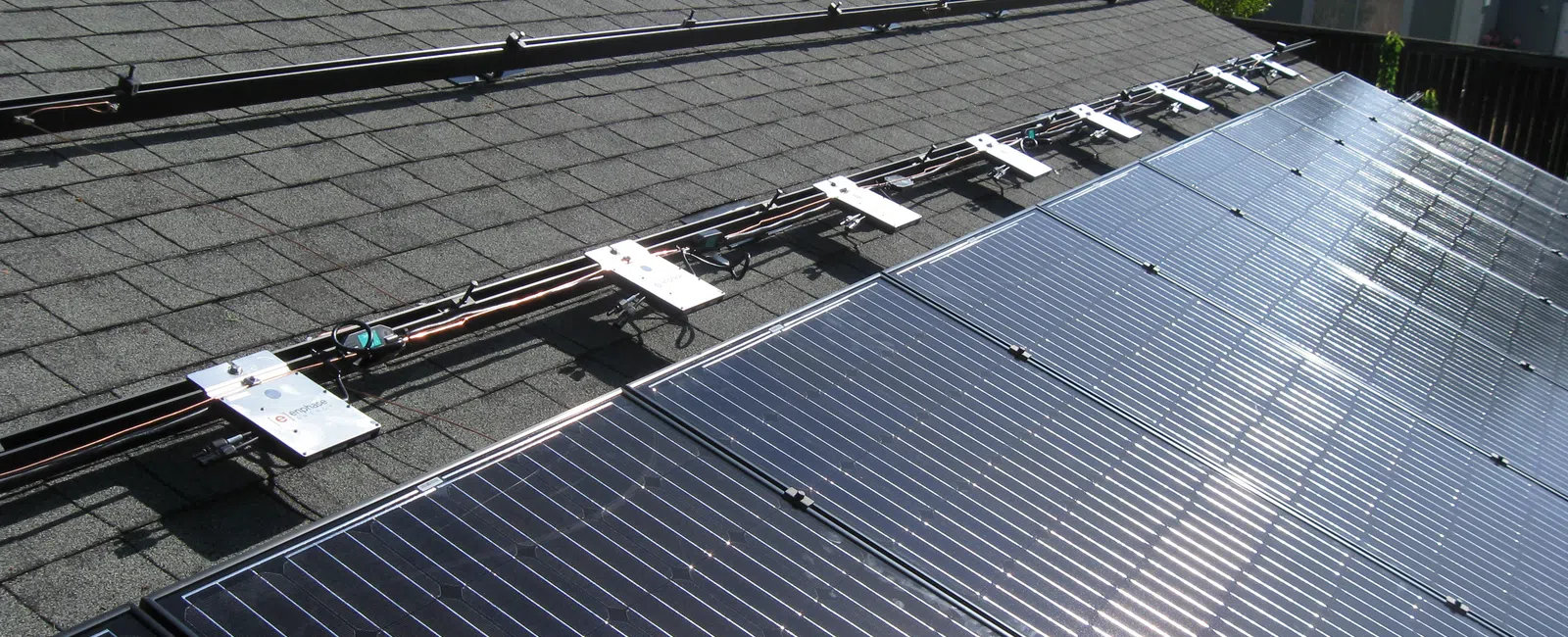
Microinverters flip the design. Instead of one central unit, a small inverter sits under each panel, converting that panel's power right there on the roof.
Because each panel has its own inverter, each one produces independently. A shaded panel only affects itself. The rest of the array keeps doing its thing. That independence is the main reason microinverters have become so common on residential roofs.
Enphase is the best-known name here, and it's a platform we install. The other advantage is visibility: because each panel reports on its own, you get panel-level monitoring, so you can see exactly how every panel is performing rather than just the total from the whole system.
Where the difference really shows up
Three situations separate them.
- Shade. If any part of your roof is shaded by a tree, a chimney, or a neighboring building at some point during the day, microinverters usually make more sense. They keep one shaded panel from dragging down its neighbors.
- Multiple roof angles. A roof with several faces pointing different directions is common, and it's a natural fit for microinverters, since each panel produces on its own regardless of which direction it faces. It's one of the reasons a mixed roof isn't the obstacle people assume, as we cover in which direction solar panels should face.
- Monitoring. With a string inverter, you see your system's total output. With microinverters, you see each panel. If production ever dips, panel-level data makes it much easier to pinpoint where, which is handy for the light service and maintenance solar needs over the years.
A middle option: optimizers
There's a third setup worth knowing about. Power optimizers pair a small device with each panel, as microinverters do, but they still send power to a central inverter for the actual conversion. The idea is to achieve panel-level performance and monitoring while keeping a single main inverter to do the heavy lifting.
It's a legitimate approach, and it sits between the two, which is a good reminder that this isn't really a two-way choice. It's a design decision with a few paths, and the right one depends on your roof rather than on which technology sounds best.
What about service down the road?
This is worth thinking through, because inverters work harder than panels and generally have shorter lives than the 25-plus years your panels are built for.
- With a string inverter, that eventual replacement is concentrated in one unit. It's a single planned service visit at ground level, simple and predictable.
- With microinverters, the work is spread across the array, one small unit per panel, and they sit up on the roof. Individual failures are uncommon, and with panel-level monitoring, you'd know precisely which one needed attention rather than guessing.
Neither is a problem. They're just different service pictures, and it's the kind of thing worth knowing before you buy rather than learning about in year twelve.
So which one is right for your home?
There's no universal winner, which is exactly why we don't hand every customer the same system. A simple, unshaded roof with one good orientation is a fine candidate for a string inverter. A roof with shade, several angles, or an unusual layout is often better served by microinverters. Your budget and how closely you want to monitor your system's performance also factor in.
We review it all during the site visit, recommend the setup that fits your roof, and then design the entire solar system around it. If a battery is part of your plan, that shapes the recommendation as well, since the inverter and battery storage need to work together as one system.
That's the benefit of working with a local company that designs each system from scratch. We're 100% employee-owned, we've worked across Marin, Sonoma, and Napa since 1984, and we've installed more than 9,000 systems. We're licensed as a General Contractor (B) and Electrical Contractor (C-10), and we were one of the first companies in California to earn the state's C-46 solar license, so the people recommending your inverter are the same licensed team that installs and services it.
Want to know which setup suits your roof? Contact SolarCraft or call Sonoma/Napa 707.778.0568 or Marin 415.382.7717.