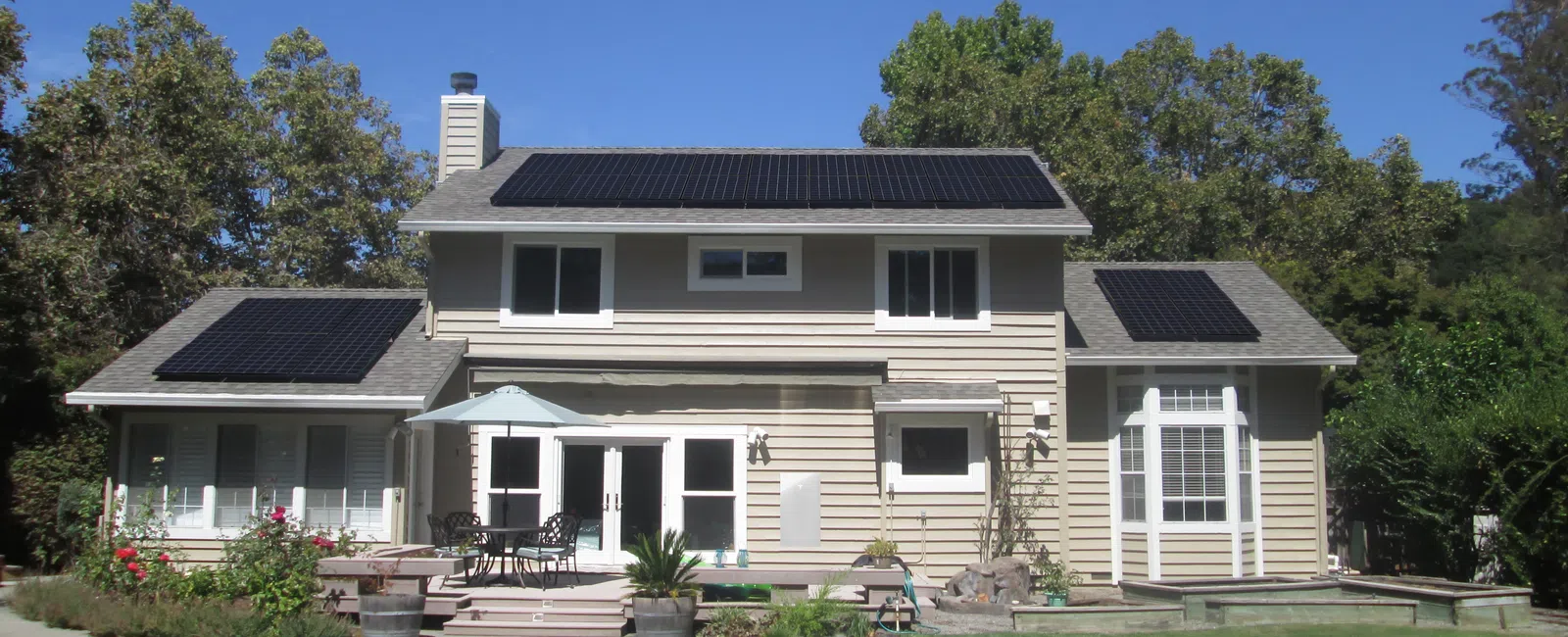
Most homes go solar with panels on the roof, and for good reason: it puts space you already have to work without giving up an inch of your yard. But roof-mount isn't your only option. If you've got open land, a shaded or complex roof, or simply want a larger system than your roof can hold, a ground-mounted array can be the better choice. Both are excellent ways to power your home, and the right one depends on your property and goals.
Roof-mount solar: the most common choice
For most North Bay homes, roof-mount is the natural pick. Your roof is already there; it's usually the sunniest open space on the property, and installing panels there keeps your yard clear. Because it uses the structure you already have, a roof-mount system is typically the more affordable of the two, with no foundation or trenching to add.
Roof-mount works best when your roof gets good sun, has enough unshaded space for the system you want, and has plenty of life left in it. We check all of that during the site visit. If your roof is in good shape and gets good sun, panels on top are usually the simplest way to lower your bills.
Roof type matters less than you might think, too. We install on tile, composition shingle, metal, and flat roofs, including the foam roofs on Eichler homes, which are a specialty of ours and a job most solar companies turn down. We've worked out how to mount solar on Eichler foam roofs properly, without compromising the roof. So if another company told you your roof was a problem, it's worth a second opinion before you rule out a roof-mount system.
Ground-mount solar: when the land is a better fit
A ground-mounted array sits on a frame anchored into the ground, usually in an open, sunny part of your property. It's the better option in a few situations.
- Your roof isn't ideal. If your roof is heavily shaded, broken up by dormers and vents, faces the wrong way, or is near the end of its life, the ground can be a better home for your panels.
- You want a larger system. Ground mounts aren't limited by your roof's size, so if you use a lot of power, run a well pump, charge EVs, or want to cover a larger share of your usage, there's room to scale up.
- You have the land for it. Rural and vineyard properties, larger lots, and homes with open southern exposure are ideal candidates, and the North Bay has plenty of them.
Because a ground mount can be built at the ideal angle and pointed in the best direction, it often makes excellent use of the sun. It's also easy to reach for cleaning and service, since everything sits at ground level.
What a ground-mount install involves
A ground mount takes a bit more site work than a roof install, and it helps to know what that includes. The array sits on a steel frame anchored with driven posts, ground screws, or concrete footings, depending on your soil. We run the wiring from the array back to your home's electrical panel, usually in a trench, and tie it in the same way a roof system connects. A ground mount also needs a clear, open area with good sun and room to work, and local setback rules sometimes shape where it can go. None of this is complicated on our end. We handle the design, site prep, and permits as part of the project, so it's a straightforward process for you.
How the two compare
A few practical differences help sort it out.
- Cost. Roof-mount is usually less expensive because it uses your existing structure. A ground mount adds a foundation, framing, and trenching to run wiring back to the house, so it typically costs more. What you get for that is freedom of placement and room to grow.
- Space. Roof-mount uses space you aren't otherwise using. A ground mount trades a piece of your land for panels, which is easy on a large lot and less practical on a small one.
- Production. Both produce plenty of power. A ground mount can be angled and aimed for the best possible sun, while a roof-mount system works with the angles your roof already has. On a good roof, that difference is small.
- Access. Ground-mounted panels are simple to reach for cleaning and maintenance. Roof panels sit higher up, though they need very little attention either way.
- Looks. Some homeowners prefer keeping panels off the roofline, and others would rather not give up any yard. It comes down to what suits your property and your taste.
How we help you choose
There's no single right answer here, which is why we start with your property. During the site visit, we assess your roof's condition, orientation, and shading; the open space on your lot; your electrical setup; and how much power you use. From there, we design the solar system that delivers the most for your home, whether that's on the roof, on the ground, or a mix of both. If a battery is part of your plan, we design battery storage into either approach, so you can use your own power in the evening and keep your most important circuits running during an outage.
We've been designing and building both kinds of systems across Marin, Sonoma, and Napa since 1984. We're 100% employee-owned, we've installed more than 9,000 systems, and we're licensed as a General Contractor (B) and Electrical Contractor (C-10). We were also among the first companies in California to earn the state's C-46 solar license, so the same local team handles your design, permitting, and installation from start to finish.
Plenty of North Bay homes end up with a combination, panels on the best section of the roof and a ground array to make up the rest, and we're glad to design it that way when it gets you the most power. Whatever the layout, we build it to last for decades and to fit the way you really live, from the number of panels down to where the conduit runs.
Not sure which fits your property? Contact SolarCraft or call Sonoma/Napa 707.778.0568 or Marin 415.382.7717.