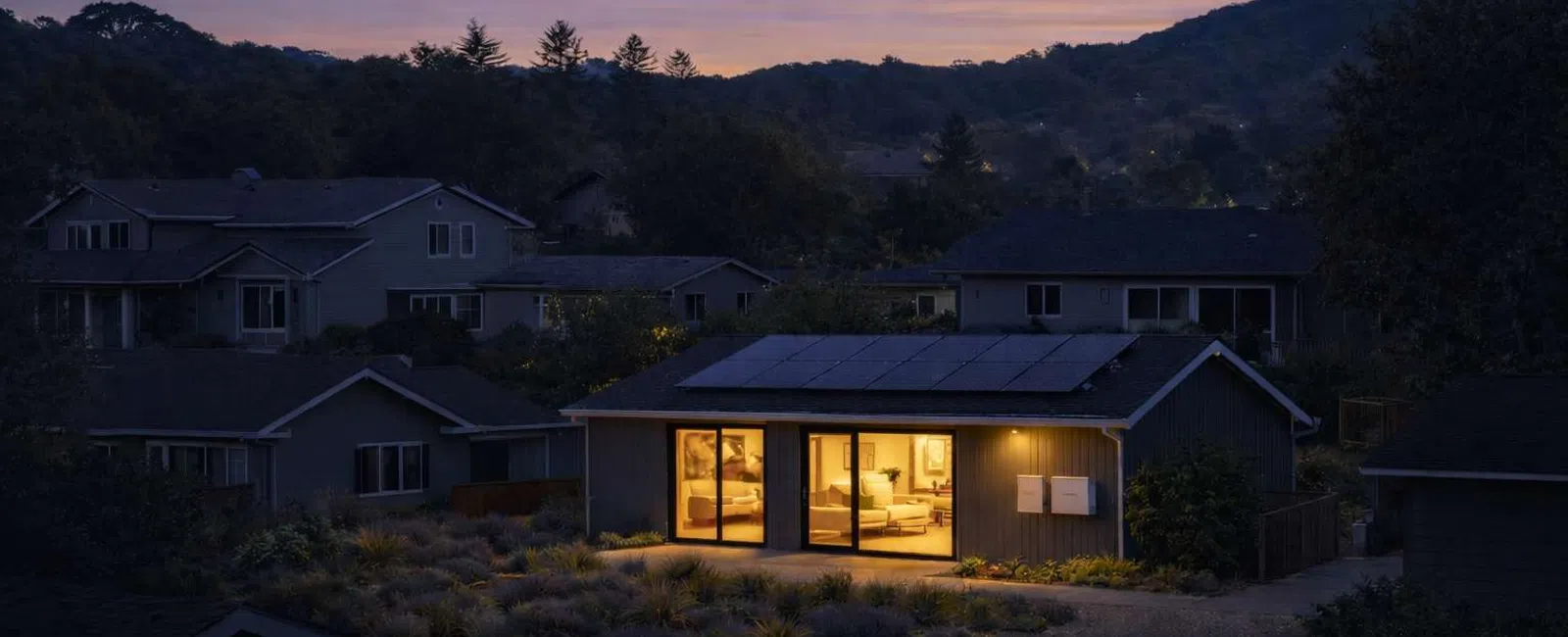
Most outages are over in a few hours, but winter storms can stretch them into a day or more. A little preparation now makes either one easier to handle: a basic supply kit, a plan for your food and devices, and a few safety habits.
If you want to stop planning around outages altogether, a backup battery keeps your home running automatically when the grid goes down.
Build a basic outage kit
Keep these in one place that everyone in the house knows about:
- Keep flashlights or battery-powered lanterns in each room you use most, with spare batteries. Skip candles when you can, since they're a fire risk.
- A battery-powered or hand-crank radio for updates if cell service or internet goes down.
- Portable power banks, kept charged, for phones and small devices.
- Drinking water, especially if your home relies on a well pump that needs electricity.
- Shelf-stable food that doesn't need cooking, plus a manual can opener.
- A basic first aid kit and any medications your household needs.
- Warm layers and blankets for winter outages.
Check the kit at the start of each storm season. Power banks lose charge over time, and people often borrow spare batteries.
Know how to protect your food
A closed refrigerator generally keeps food cold for about four hours. A full freezer holds its temperature for roughly two days, and a half-full one for about one. The single best thing you can do is keep the doors shut.
Before a storm, set your refrigerator and freezer to their coldest settings and fill empty freezer space with water containers to freeze. A thermometer in each one tells you whether food stayed at a safe temperature. When in doubt about anything perishable, throw it out.
Keep your devices charged
When a storm is forecast, charge phones, laptops, and power banks ahead of time. Save phone battery during an outage by lowering screen brightness, closing unused apps, and switching to low-power mode. A car can charge phones in a pinch, but only run it outdoors, never in a garage.
If anyone in your home relies on powered medical equipment, talk with the provider about a backup plan before storm season.
Protect your electronics and appliances
When power returns, it can come back with a surge. Unplug sensitive electronics such as computers and TVs during an outage, or keep them on surge protectors. Leave one light switched on so you know when power is restored, then turn things back on gradually rather than all at once.
A few safety basics
- Never run a portable generator, grill, or camp stove indoors or in a garage. They produce odorless, dangerous carbon monoxide.
- Make sure your home has working carbon monoxide and smoke detectors with fresh batteries.
- Stay away from downed power lines and report them to PG&E.
- Know how to open your garage door manually, since many openers won't work without power.
Have a household plan
Make sure everyone knows where the kit is, how to reach each other if phones are spotty, and who checks on neighbors who might need help. If you have a home battery, everyone should know which circuits it powers, so nobody is surprised when the dryer doesn't run, but the lights and refrigerator do.
The long-term fix: a backup battery
A kit gets you through an outage. A backup battery means you barely notice one.
When the grid goes down, a Backup Battery takes over automatically. It needs nothing to start and stores no fuel. Your refrigerator stays cold, the lights stay on, the internet keeps working, and phones stay charged. Paired with solar, your panels recharge the battery during the day, so stored power isn't limited to a single charge. Most of the checklist above, from the cooler to the power banks, becomes a fallback rather than the plan.
A Backup Battery also earns its keep on normal days by storing daytime solar for the expensive evening hours. A Savings Battery does that daily job too, but it isn't set up to power your home during an outage, so if outage protection is your goal, choose a Backup Battery. Our post on choosing what your battery backs up explains how to decide between powering a few key circuits and most of the home.
With winter storms on the way, it helps to start early. Installing a battery involves design, permitting, and PG&E approval, and those steps take time. Our post on storm season and battery backup explains why a battery usually beats a generator for most homes.
If you already have a battery
Take a few minutes before storm season:
- Increase your backup reserve so you have more charge for outages. Shorter winter days mean less sun to recharge, so a bigger cushion helps. Our post on home battery settings explains how.
- Check that your monitoring app is connected and shows the battery charging normally.
- Confirm which circuits are backed up, and make sure everyone in the household knows.
Get ready before the next storm
Preparation is worth doing whether or not you have a battery. If you want your home to keep running on its own next time, we've been designing and installing battery storage across Marin, Sonoma, and Napa since 1984. We're 100% employee-owned, licensed as a General Contractor (B) and Electrical Contractor (C-10), and one of the first companies in California to obtain the state's C-46 solar license.
Want backup power in place before winter? Contact SolarCraft or call Sonoma/Napa 707.778.0568 or Marin 415.382.7717.